Thank you for your interest in St. Andrew's Scots School
Admission for February 2027 has closed. For any enquiries or further information, the Admissions team is available via email at admissions@sanandres.esc.edu.ar
We appreciate your interest in our School and look forward to supporting you throughout the admissions process.
Admissions
2026
For entry in August 2026
Only for students coming from abroad until Y10
Application Due Dates
June 1st 2026
Admissions
2027
For entry in February 2027
Kindergarten, Primary & Secondary
Application Due Dates
August 15th 2026
For entry in August 2026
Only for students coming from abroad until Y10
Application Due Dates
June 1st 2026

How to begin the Admissions process to St. Andrew’s Scots School?
To begin the process, the family must contact the Admissions team at admissions@sanandres.esc.edu.ar who will send the admission form.
When should I begin with the Admissions process for entry in 2026?
The admission process always takes place one year before entry. The process for 2026 starts on April 1st and closes on August 15th, 2025.
The first point of entry is the 2-year-old class for children who turn 2 before June
30th of the year they join.
The academic year starts in February and ends in December. For students coming from abroad, entry may exceptionally take place in August. The deadline for August admission is June 1st of the same year of entry.
When is the closing date for to students coming from abroad starting in August?
June 1st is the registration closing date. By that date, the family must have
completed the admissions requirements. Students are not admitted to join after the second semester of the academic year
has started.
For students coming from schools following the Northern Hemisphere calendar,
admission will be determined as follows:
Initial level: based on date of birth, subject to the outcome of the Admissions Process.
Primary: based on date of birth, subject to the outcome of the Admissions Evaluation.
Secondary: based on the year completed, subject to the outcome of the Admissions Evaluation.
The final opportunity to apply to St.Andrew's Scots School is February of Year 11, since it is required to complete the last two years at the school in order to prepare for the IB exams.
Can I schedule a remote interview? (For example, via Zoom)
Informative meetings can be held online via Zoom. However, this does not replace the Admissions Interview, which must be conducted in person in Buenos Aires, aside from exceptional circumstances.
Where is the school located?
The Kindergarten and the Primary School are located in the New Campus, Atilio Betti 3199, San Fernando. The Secondary School is located in Roque Sáenz Peña 601, Olivos.
Does the school offer a transportation service?
Transport is arranged privately and directly between families and the transport companies suggested by the school. The school oversees the service and ensures that transportation can cover all possible areas.
Is St. Andrew's Scots School a religious school?
St. Andrew’s Scots School offers a bilingual, secular and co-ed education. It encourages its community to grow in openness and tolerance, valuing all faiths as well as those who do not hold any particular faith. However, the school is founded on Presbyterian values and especially promotes integrity, responsibility and respect.
Does the school offer Educational Psychology support?
St. Andrew's has Learning Support Teams composed of professionals in psychopedagogy, psychology and related fields, available across all levels.
What emergency services are available at the the school?
The school has an in-house doctor in the Olivos pool area. On the Campus, there is both an in-house doctor and a nurse present at all times. Additionally, there is an emergency service located at the Campus entrance. The school staff receives annual CPR training.
How many foreign families are there at the school?
The percentage of foreign families varies over the years but it generally represents around 10% of the total population. We have many families where one of the parents is foreign, or who have lived abroad and choose St. Andrew's upon their return to Buenos Aires.
What areas do the families in our community live in?
The school community consists of a wide range of families from both the City of Buenos Aires (CABA) and the Northern Zone of Gran Buenos Aires including neighbouring areas around the Campus.
What is the involvement of parents in the school?
Communication with parents is open an continuos. Regular informative meetings are held, and throughout the year, activities for the whole family are organised, such as the Family Day, Interhouses events, Values Night, Choir & Drama for parents, etc.
All parents joining our community are welcome to become involved in APESA, the Parent Association at St. Andrew's and participate actively.
Does the school grant discounts and / or scholarships?
The school offers siblings discounts (10% for the second child, 40% for the third child and 75% for the fourth child and beyond). Alumni who enrol, as well as members of the Faith Community can apply for scholarships offered by the Fundación San Andrés.
How is security managed at the school?
Security is managed by school staff specifically hired for this role.
How are new families integrated into our community?
The school's Parent Association (APESA) coordinates the Welcome SASS program, where an existing family welcomes a new family to help them settle in and facilitate the adaptation of new students.
Where can I buy the school uniform?
The School Shop, located at both Olivos and Campus sites, sells uniforms. Parents can purchase them both at the Olivos and the Campus School Shops that are open every day during school hours.
What is the Kindergarten timetable?
The Kindergarten offers a landing window every day from 8am to 8.30am. Formal activities begin at 8.30am. For K2, K3 & K4 students, activities finish at 12pm.
K5 students are required to stay until 4pm.
K3 and K4 students can participate in optional afternoon workshops from Monday to Thursday, from 1pm to 4pm.
How many students are there in each class?
The maximum number of students in K2 is 18 children, with two teachers present in each room. From K3 onwards, the number may increase to 22 students per class.
How many teachers are there in each classroom?
In Kindergarten, each class has a lead teacher and a permanent assistant.
Additionally, a team of educational psychology professionals perform personalised monitoring of every student.
What is the structure of bilingual education in Kindergarten?
Each age group has its own educational community, consisting of six divisions and a common space called the Cluster. Students use these spaces together to explore creativity and socialisation.
Activities are mostly conducted in English; learning occurs through games and songs that allow students to incorporate the language in an organic and playful way.
What is a Cluster?
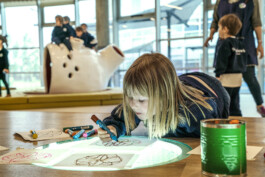
It is an exclusive common space for each level, equipped with age-appropriate materials. Designed by the Rosan Bosch studio to stimulate imagination and creativity, children play in stations rotating the activities & divided into small groups.
What is the modality of the K3 and K4 workshops?
Workshops for K3 and K4 are optional and run from 1pm to 4pm from Monday to Thursday. Students may choose to attend twice a week (Monday & Wednesday or Tuesday & Thursday) or all four days. The available workshops include:
Robotics and Technology
Makerspace, Construction and Exploration
Sports and Games
Cook and Play
Performing Arts
Creative expression
Yoga and Mindfulness
Outdoor Learning
These workshops rotate, allowing all students to participate in all areas, regardless of which days they attend.
What other activities are included in the curriculum?
Within the curriculum schedule, students have Music and Physical Education.
There is an annual Concert and a Sports event where all families are welcome.
What is the presence of technology in Kindergarten?
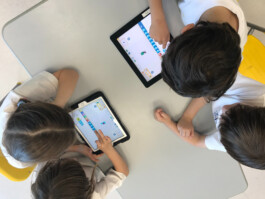
While the use of technology is not a primary goal in Kindergarten, it is present for specific activities involving interactive whiteboards and iPads, as well as in the Robotics and initiation to coding workshops.
How does lunch take place in the Kindergarten?
Those children attending the full day, can choose to bring their lunchbox from home or use the school´s lunch service. All students have lunch together with their teachers and peers. The menu offered by the school´s lunch service is designed and supervised by nutritionists and can always be consulted on the school´s communication platform.
Where does outdoor play take place?
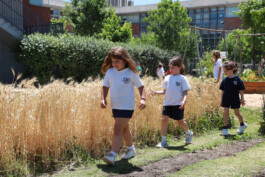
Kinder 2 and Kinder 3 classrooms have direct access to their own private garden, where children enjoy playtime in the sandbox, on the merry-go-round, slide and other games, exclusively with their age group.
In the main playground, in addition to the mentioned games, there are also swings and a small synthetic grass field for use by Kinder 4 and Kinder 5 children.
What is the Primary School timetable?
The Primary School is open from 7:30 am. Between 7:55 and 8:15 am, there is an optional pre-hour. Mandatory activities begin at 8:15am and continue until 4:20pm.
How many students are there in each class?
Primary School divides each age group into six divisions of 22 students per class, from Year 1 to Year 3, and 24 students per class from Year 4 onward. In all primary grades, students share a common space called Cluster, exclusive for each sector.
The ratio of boys to girls per class is balanced.
How many teachers are there per classroom?
Each group has one Spanish teacher, one English teacher, and an assistant who divides her time to assist students who need support. It´s worth mentioning that each educational community has a Lead Teacher who oversees the work of the teaching team for that grade.
What is the structure of the bilingual education?
The day is divided into equal activities in English and in Spanish.
What is the Primary School's methodology?
St. Andrew's Scots School has its own curriculum that adheres to the national curriculum. The learning is holistic, aiming to stimulate students´; curiosity through various research projects where subjects are interrelated. Learning is project-based, focusing on helping students discover themselves and their interests to become lifelong learners. The school encourages students to take ownership of their learning processes, working with autonomy and responsibility. Students work in small groups from 70% of the day and individually for 30%, rotating teams for different activities.
What is a Cluster?
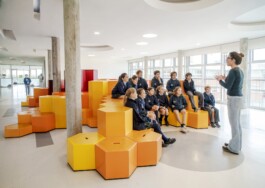
Clusters are common spaces where students explore and work in station-based learning. These spaces reflect the different stages of learning, such as introspection areas, experimentation spaces, collaborative workspaces, presentation areas and one-way communication spaces. They are equipped with furniture designed by Rosan Bosch studio, meant to stimulate creativity and imagination.
Do students receive Educational Psychology support?
Educational Psychology professionals accompany the process of each student, addressing their specific needs.
Do students engage in community work?
Through SEIL (Social, Emotional Intelligence and Leadership) students work on Emotional Education, peer relationships, and community work with each student. They participate in various activities to become active members of the community.
Is there a Library at school?
The Primary building houses a large Library located at the heart of the school. The library has special areas to encourage reading, storytelling, narration and research, along with a multimedia space and collaborative work tables. Students visit the library periodically for various activities.
What activities are part of the curriculum for primary students?
Within the curriculum, students have Drama, Music, Art and Sports.
What is the presence of Technology in Primary?
Technology is considered an important tool in the everyday learning process. During the first years, students use devices provided by the school and in the last years of Primary they use their own. There is also a Technology Lab where students learn Robotics, Decoding, Digital Design, and more.
The school provides devices for students in Year 1, Year 2 and Year 3. From Year 4 onward, students use their own devices.
Which are the Sports that students practice in Primary?
Swimming, Hockey, Rugby and Athletics.
Where do students practice swimming? As from what age?
Swimming begins in Year 1. Classes are held at Club Buenavista, close to the school. Secondary school has its own pool at the Olivos site.
What activities do students do in Music?
All Primary school students participate in the School Play combining Drama and Music activities. Children can also join the School Choir and the Primary School Band. As from Year 4, those who take part in the School of Instruments can choose an instrument to learn.
How does lunch take place?
Families have the option of choosing between the school´s lunch service or for each child to bring their own lunchbox. All students have their lunch together in the hall, and eat in shifts according to their sector and grade.
What trips do Primary students take?
Primary students go on camps and sports trips within the country or to neighbouring countries like Uruguay. At the end of Primary, Year 6 students go on a trip within Argentina to mark the conclusion of this educational stage.
How often are divisions reshuffled?
To encourage socialisation and interaction among all children of the same age, classes are reorganised at the beginning of Kindergarten 5, 4th grade in primary and 7th grade when entering Secondary School.
Which workshops can student choose within school hours?
Art Attack, Scottish dancing, Chess, Robotics, Choir, Band
What is the Secondary School timetable?
Secondary School opens at 7:30 am. Formal mandatory activities begin at 8:00 am and run until 4:10 pm. Two afternoons a week, students have sports activity that can take place in Olivos or in the new Campus, depending on their choice.
Where is the Secondary School located?
Secondary is divided into two buildings. The Intermediate School building, for Y7, Y8 and Y9 students, is located at Nogoyá 550, Olivos. The Senior School building, for Y10, Y11 and Y12 students, is located at Roque Saenz Peña 601, Olivos.
How many students are there per class?
In Secondary School, there are six divisions per year, with between 22 and 24 students per class.
How many teachers do students have per class?
Secondary School students have a Tutor for each division. The Tutor´s role is to guide and provide personalised attention to the specific needs of each student. Then, each course has its own specialised teacher.
In Y7 and Y8, students have the same tutor to accompany them throughout their early years in Secondary school.
Do students remain in the same peer group throughout their time in Secondary School?
Students remain in the same group during Y7 and Y8. As from Y9, students are grouped according to their subject choices.
What is the structure of bilingual education?
From the first years of Secondary, classes are conducted in English for 55% of the total hours, and this percentage progressively increases as students advance. The Intermediate School (Y7, Y8 and Y9) integrates the Sea of Learning program. All Secondary school students follow the IB program in order to obtain the diploma at the end of their schooling in Y12.
The School may consider admitting a student learning Spanish, but they will eventually need to meet the language requirements to pass all courses.
What is the school's goal regarding learning?
The school seeks to promote enthusiasm for learning. Project-based learning helps students understand themselves and their interests. We believe that when students are active and solve real-world problems collaboratively, they develop useful life skills. Effective learning requires diverse approaches and variety of teaching experiences.
The goal is for students to:
Have increased access to excellent learning experiences of all kinds.
Be prepared for University.
Be prepared for life in the 21st century with competent skills and values.
Have enthusiasm and enjoyment for learning, as well as an entrepreneurial spirit.
What is Sea of Learning?
Sea of Learning is a program designed by the school for Y7, Y8 and Y9, where students work through projects, problems and phenomena explicitly connected to the real world through cross-curricular learning.
It is based on six fundamental pillars:
Creativity, Communication, Citizenship, Critical thinking, Character & Collaboration.
What international exams do students take in Secondary?
In Y10, students take the Cambridge IGCSE (International General Certificate) in English and the UdeSA Diploma in Mathematics and Spanish. In Y12, all students sit for the IB diploma exams.
What IB subjects does the school offer? (HL: Higher level, SL Standard level)
English HL / SL
Spanish HL / SL
Literature
Mathematics HL / SL
Business & Management HL
Economics HL / SL
History HL / SL
I.T.G.S HL / SL
Environmental systems and societies SL
Biology HL / SL
Chemistry HL / SL
Physics HL / SL
Sports Exercise and Health Science SL
Art HL / SL
Film HL / SL
Theater HL / SL
French HL / SL
Mandarin SL
Portuguese S
What is Flextime?
Everyday, students have a time slot between 10:00 and 10:40 am when Flextime takes place. It is a time where all students choose which activity to participate in. Options include relaxation spaces, tutoring, reading, community or individual workspaces, and creative workspaces. The goal of this proposal is for students to organise their time responsibly to optimise their work.
What Music activities are offered within the curriculum?
The school offers Art, Drama and Music, where students can participate in the School Choir, join the School Band and the School Play.
What Sports are promoted at school?
Students choose a main sport to practice within school hours between:
Swimming, Hockey, Rugby, Athletics, Volley and Basketball
Where do students practice swimming?
Secondary School students carry out swimming in the heated pool situated at the Intermediate School building.
Where do students practice other sports?
Students practice Volleyball and Basketball at the Intermediate School gym. Rugby and Hockey practices take place at the Campus courts (grass and synthetic grass fields).
How do students have lunch? Do they have lunch all together?
Students can choose to contract the school´s lunch service or bring their own lunch. They have lunch in shifts at the school´s dining room.
How does school handle issues such as bullying, drugs and alcohol?
The school works proactively through open communication among students, parents and teachers. We believe prevention is the best way to tackle adolescent issues.
Through S.E.I.L (Social, Emotional Intelligence and Leadership), teachers, psychologists, tutors and educational psychologists coordinate activities and spaces for reflection, debate and support. In this subject, students also engage in community work, collaborating with various entities.
Informative talks are also held for parents, addressing specific age-group issues and areas of concern.
What trips do students take in Secondary School?
Secondary School students go on retreats annually. They also have a wide range of international trips related to sports tours, exchanges and study trips. Destinations depend on the subjects students choose.
What other languages are taught at the school?
Students from Year 7 must choose a third language from Mandarin, French or Portuguese as part of the curriculum.
Thank you for your interest in St. Andrew's Scots School
Admission for February 2027 has closed. For any enquiries or further information, the Admissions team is available via email at admissions@sanandres.esc.edu.ar
We appreciate your interest in our School and look forward to supporting you throughout the admissions process.
Admissions
2024
For entry in August 2024
Only for students coming from abroad until Y10
Application Due Dates
June 1st 2024
Admissions
2027
For entry in February 2027
Kindergarten, Primary & Secondary
Application Due Dates
August 15th 2026
For entry in August 2026
Only for students coming from abroad until Y10
Application Due Dates
June 1st 2026
How to begin the Admissions process to St. Andrew’s Scots School?
To begin the process, the family must contact the Admissions team at admissions@sanandres.esc.edu.ar who will send the admission form.
When should I begin with the Admissions process for entry in 2026?
The admission process always takes place one year before entry. The process for 2026 starts on April 1st and closes on August 15th, 2025.
The first point of entry is the 2-year-old class for children who turn 2 before June
30th of the year they join.
The academic year starts in February and ends in December. For students coming from abroad, entry may exceptionally take place in August. The deadline for August admission is June 1st of the same year of entry.
When is the closing date for to students coming from abroad starting in August?
June 1st is the registration closing date. By that date, the family must have
completed the admissions requirements. Students are not admitted to join after the second semester of the academic year
has started.
For students coming from schools following the Northern Hemisphere calendar,
admission will be determined as follows:
Initial level: based on date of birth, subject to the outcome of the Admissions Process.
Primary: based on date of birth, subject to the outcome of the Admissions Evaluation.
Secondary: based on the year completed, subject to the outcome of the Admissions Evaluation.
The final opportunity to apply to St.Andrew's Scots School is February of Year 11, since it is required to complete the last two years at the school in order to prepare for the IB exams.
Can I schedule a remote interview? (For example, via Zoom)
Informative meetings can be held online via Zoom. However, this does not replace the Admissions Interview, which must be conducted in person in Buenos Aires, aside from exceptional circumstances.
Where is the school located?
The Kindergarten and the Primary School are located in the New Campus, Atilio Betti 3199, San Fernando. The Secondary School is located in Roque Sáenz Peña 601, Olivos.
Does the school offer a transportation service?
Transport is arranged privately and directly between families and the transport companies suggested by the school. The school oversees the service and ensures that transportation can cover all possible areas.
Is St. Andrew's Scots School a religious school?
St. Andrew’s Scots School offers a bilingual, secular and co-ed education. It encourages its community to grow in openness and tolerance, valuing all faiths as well as those who do not hold any particular faith. However, the school is founded on Presbyterian values and especially promotes integrity, responsibility and respect.
Does the school offer Educational Psychology support?
St. Andrew's has Learning Support Teams composed of professionals in psychopedagogy, psychology and related fields, available across all levels.
What emergency services are available at the the school?
The school has an in-house doctor in the Olivos pool area. On the Campus, there is both an in-house doctor and a nurse present at all times. Additionally, there is an emergency service located at the Campus entrance. The school staff receives annual CPR training.
How many foreign families are there at the school?
The percentage of foreign families varies over the years but it generally represents around 10% of the total population. We have many families where one of the parents is foreign, or who have lived abroad and choose St. Andrew's upon their return to Buenos Aires.
What areas do the families in our community live in?
The school community consists of a wide range of families from both the City of Buenos Aires (CABA) and the Northern Zone of Gran Buenos Aires including neighbouring areas around the Campus.
What is the involvement of parents in the school?
Communication with parents is open an continuos. Regular informative meetings are held, and throughout the year, activities for the whole family are organised, such as the Family Day, Interhouses events, Values Night, Choir & Drama for parents, etc.
All parents joining our community are welcome to become involved in APESA, the Parent Association at St. Andrew's and participate actively.
Does the school grant discounts and / or scholarships?
The school offers siblings discounts (10% for the second child, 40% for the third child and 75% for the fourth child and beyond). Alumni who enrol, as well as members of the Faith Community can apply for scholarships offered by the Fundación San Andrés.
How is security managed at the school?
Security is managed by school staff specifically hired for this role.
How are new families integrated into our community?
The school's Parent Association (APESA) coordinates the Welcome SASS program, where an existing family welcomes a new family to help them settle in and facilitate the adaptation of new students.
Where can I buy the school uniform?
The School Shop, located at both Olivos and Campus sites, sells uniforms. Parents can purchase them both at the Olivos and the Campus School Shops that are open every day during school hours.
What is the Kindergarten timetable?
The Kindergarten offers a landing window every day from 8am to 8.30am. Formal activities begin at 8.30am. For K2, K3 & K4 students, activities finish at 12pm.
K5 students are required to stay until 4pm.
K3 and K4 students can participate in optional afternoon workshops from Monday to Thursday, from 1pm to 4pm.
How many students are there in each class?
The maximum number of students in K2 is 18 children, with two teachers present in each room. From K3 onwards, the number may increase to 22 students per class.
How many teachers are there in each classroom?
In Kindergarten, each class has a lead teacher and a permanent assistant.
Additionally, a team of educational psychology professionals perform personalised monitoring of every student.
What is the structure of bilingual education in Kindergarten?
Each age group has its own educational community, consisting of six divisions and a common space called the Cluster. Students use these spaces together to explore creativity and socialisation.
Activities are mostly conducted in English; learning occurs through games and songs that allow students to incorporate the language in an organic and playful way.
What is a Cluster?
It is an exclusive common space for each level, equipped with age-appropriate materials. Designed by the Rosan Bosch studio to stimulate imagination and creativity, children play in stations rotating the activities & divided into small groups.
What is the modality of the K3 and K4 workshops?
Workshops for K3 and K4 are optional and run from 1pm to 4pm from Monday to Thursday. Students may choose to attend twice a week (Monday & Wednesday or Tuesday & Thursday) or all four days. The available workshops include:
Robotics and Technology
Makerspace, Construction and Exploration
Sports and Games
Cook and Play
Performing Arts
Creative expression
Yoga and Mindfulness
Outdoor Learning
These workshops rotate, allowing all students to participate in all areas, regardless of which days they attend.
What other activities are included in the curriculum?
Within the curriculum schedule, students have Music and Physical Education.
There is an annual Concert and a Sports event where all families are welcome.
What is the presence of technology in Kindergarten?
While the use of technology is not a primary goal in Kindergarten, it is present for specific activities involving interactive whiteboards and iPads, as well as in the Robotics and initiation to coding workshops.
How does lunch take place in the Kindergarten?
Those children attending the full day, can choose to bring their lunchbox from home or use the school´s lunch service. All students have lunch together with their teachers and peers. The menu offered by the school´s lunch service is designed and supervised by nutritionists and can always be consulted on the school´s communication platform.
Where does outdoor play take place?
Kinder 2 and Kinder 3 classrooms have direct access to their own private garden, where children enjoy playtime in the sandbox, on the merry-go-round, slide and other games, exclusively with their age group.
In the main playground, in addition to the mentioned games, there are also swings and a small synthetic grass field for use by Kinder 4 and Kinder 5 children.
What is the Primary School timetable?
The Primary School is open from 7:30 am. Between 7:55 and 8:15 am, there is an optional pre-hour. Mandatory activities begin at 8:15am and continue until 4:20pm.
How many students are there in each class?
Primary School divides each age group into six divisions of 22 students per class, from Year 1 to Year 3, and 24 students per class from Year 4 onward. In all primary grades, students share a common space called Cluster, exclusive for each sector.
The ratio of boys to girls per class is balanced.
How many teachers are there per classroom?
Each group has one Spanish teacher, one English teacher, and an assistant who divides her time to assist students who need support. It´s worth mentioning that each educational community has a Lead Teacher who oversees the work of the teaching team for that grade.
What is the structure of the bilingual education?
The day is divided into equal activities in English and in Spanish.
What is the Primary School's methodology?
St. Andrew's Scots School has its own curriculum that adheres to the national curriculum. The learning is holistic, aiming to stimulate students´; curiosity through various research projects where subjects are interrelated. Learning is project-based, focusing on helping students discover themselves and their interests to become lifelong learners. The school encourages students to take ownership of their learning processes, working with autonomy and responsibility. Students work in small groups from 70% of the day and individually for 30%, rotating teams for different activities.
What is a Cluster?
Clusters are common spaces where students explore and work in station-based learning. These spaces reflect the different stages of learning, such as introspection areas, experimentation spaces, collaborative workspaces, presentation areas and one-way communication spaces. They are equipped with furniture designed by Rosan Bosch studio, meant to stimulate creativity and imagination.
Do students receive Educational Psychology support?
Educational Psychology professionals accompany the process of each student, addressing their specific needs.
Do students engage in community work?
Through SEIL (Social, Emotional Intelligence and Leadership) students work on Emotional Education, peer relationships, and community work with each student. They participate in various activities to become active members of the community.
Is there a Library at school?
The Primary building houses a large Library located at the heart of the school. The library has special areas to encourage reading, storytelling, narration and research, along with a multimedia space and collaborative work tables. Students visit the library periodically for various activities.
What activities are part of the curriculum for primary students?
Within the curriculum, students have Drama, Music, Art and Sports.
What is the presence of Technology in Primary?
Technology is considered an important tool in the everyday learning process. During the first years, students use devices provided by the school and in the last years of Primary they use their own. There is also a Technology Lab where students learn Robotics, Decoding, Digital Design, and more.
The school provides devices for students in Year 1, Year 2 and Year 3. From Year 4 onward, students use their own devices.
Which are the Sports that students practice in Primary?
Swimming, Hockey, Rugby and Athletics.
Where do students practice swimming? As from what age?
Swimming begins in Year 1. Classes are held at Club Buenavista, close to the school. Secondary school has its own pool at the Olivos site.
What activities do students do in Music?
All Primary school students participate in the School Play combining Drama and Music activities. Children can also join the School Choir and the Primary School Band. As from Year 4, those who take part in the School of Instruments can choose an instrument to learn.
How does lunch take place?
Families have the option of choosing between the school´s lunch service or for each child to bring their own lunchbox. All students have their lunch together in the hall, and eat in shifts according to their sector and grade.
What trips do Primary students take?
Primary students go on camps and sports trips within the country or to neighbouring countries like Uruguay. At the end of Primary, Year 6 students go on a trip within Argentina to mark the conclusion of this educational stage.
How often are divisions reshuffled?
To encourage socialisation and interaction among all children of the same age, classes are reorganised at the beginning of Kindergarten 5, 4th grade in primary and 7th grade when entering Secondary School.
Which workshops can student choose within school hours?
Art Attack, Scottish dancing, Chess, Robotics, Choir, Band
What is the Secondary School timetable?
Secondary School opens at 7:30 am. Formal mandatory activities begin at 8:00 am and run until 4:10 pm. Two afternoons a week, students have sports activity that can take place in Olivos or in the new Campus, depending on their choice.
Where is the Secondary School located?
Secondary is divided into two buildings. The Intermediate School building, for Y7, Y8 and Y9 students, is located at Nogoyá 550, Olivos. The Senior School building, for Y10, Y11 and Y12 students, is located at Roque Saenz Peña 601, Olivos.
How many students are there per class?
In Secondary School, there are six divisions per year, with between 22 and 24 students per class.
How many teachers do students have per class?
Secondary School students have a Tutor for each division. The Tutor´s role is to guide and provide personalised attention to the specific needs of each student. Then, each course has its own specialised teacher.
In Y7 and Y8, students have the same tutor to accompany them throughout their early years in Secondary school.
Do students remain in the same peer group throughout their time in Secondary School?
Students remain in the same group during Y7 and Y8. As from Y9, students are grouped according to their subject choices.
What is the structure of bilingual education?
From the first years of Secondary, classes are conducted in English for 55% of the total hours, and this percentage progressively increases as students advance. The Intermediate School (Y7, Y8 and Y9) integrates the Sea of Learning program. All Secondary school students follow the IB program in order to obtain the diploma at the end of their schooling in Y12.
The School may consider admitting a student learning Spanish, but they will eventually need to meet the language requirements to pass all courses.
What is the school's goal regarding learning?
The school seeks to promote enthusiasm for learning. Project-based learning helps students understand themselves and their interests. We believe that when students are active and solve real-world problems collaboratively, they develop useful life skills. Effective learning requires diverse approaches and variety of teaching experiences.
The goal is for students to:
Have increased access to excellent learning experiences of all kinds.
Be prepared for University.
Be prepared for life in the 21st century with competent skills and values.
Have enthusiasm and enjoyment for learning, as well as an entrepreneurial spirit.
What is Sea of Learning?
Sea of Learning is a program designed by the school for Y7, Y8 and Y9, where students work through projects, problems and phenomena explicitly connected to the real world through cross-curricular learning.
It is based on six fundamental pillars:
Creativity, Communication, Citizenship, Critical thinking, Character & Collaboration.
What international exams do students take in Secondary?
In Y10, students take the Cambridge IGCSE (International General Certificate) in English and the UdeSA Diploma in Mathematics and Spanish. In Y12, all students sit for the IB diploma exams.
What IB subjects does the school offer? (HL: Higher level, SL Standard level)
English HL / SL
Spanish HL / SL
Literature
Mathematics HL / SL
Business & Management HL
Economics HL / SL
History HL / SL
I.T.G.S HL / SL
Environmental systems and societies SL
Biology HL / SL
Chemistry HL / SL
Physics HL / SL
Sports Exercise and Health Science SL
Art HL / SL
Film HL / SL
Theater HL / SL
French HL / SL
Mandarin SL
Portuguese S
What is Flextime?
Everyday, students have a time slot between 10:00 and 10:40 am when Flextime takes place. It is a time where all students choose which activity to participate in. Options include relaxation spaces, tutoring, reading, community or individual workspaces, and creative workspaces. The goal of this proposal is for students to organise their time responsibly to optimise their work.
What Music activities are offered within the curriculum?
The school offers Art, Drama and Music, where students can participate in the School Choir, join the School Band and the School Play.
What Sports are promoted at school?
Students choose a main sport to practice within school hours between:
Swimming, Hockey, Rugby, Athletics, Volley and Basketball
Where do students practice swimming?
Secondary School students carry out swimming in the heated pool situated at the Intermediate School building.
Where do students practice other sports?
Students practice Volleyball and Basketball at the Intermediate School gym. Rugby and Hockey practices take place at the Campus courts (grass and synthetic grass fields).
How do students have lunch? Do they have lunch all together?
Students can choose to contract the school´s lunch service or bring their own lunch. They have lunch in shifts at the school´s dining room.
How does school handle issues such as bullying, drugs and alcohol?
The school works proactively through open communication among students, parents and teachers. We believe prevention is the best way to tackle adolescent issues.
Through S.E.I.L (Social, Emotional Intelligence and Leadership), teachers, psychologists, tutors and educational psychologists coordinate activities and spaces for reflection, debate and support. In this subject, students also engage in community work, collaborating with various entities.
Informative talks are also held for parents, addressing specific age-group issues and areas of concern.
What trips do students take in Secondary School?
Secondary School students go on retreats annually. They also have a wide range of international trips related to sports tours, exchanges and study trips. Destinations depend on the subjects students choose.
What other languages are taught at the school?
Students from Year 7 must choose a third language from Mandarin, French or Portuguese as part of the curriculum.
Copyright © 2025 St. Andrew's Scots School. All rights reserved.