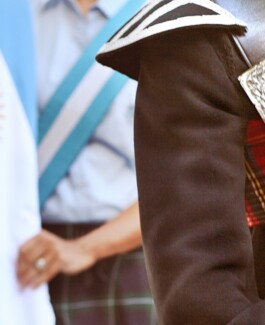

St. Andrew's Scots School was established by a group of Scottish settlers to educate their children in their language, culture and faith. On September 1st 1838, thirteen years after their arrival, a tiny school was opened in the Presbyterian Church at Piedras 55, in the city of Buenos Aires. The first pupils were only girls but the school rapidly became co-educational.
The founders sought to integrate Christian faith and practice with academic distinction. In their eyes, education was an instrument of moral training, directed to its highest purpose when it is made not merely an exercise of the mind but a training of the opinions, disposition and habits. In character undoubtedly lies the essential elements of human happiness or human misery.
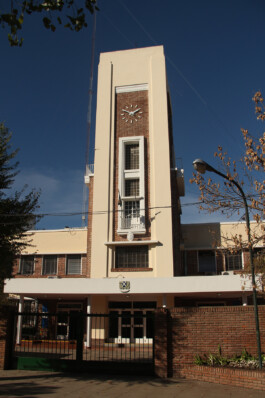
In 1885, the Scottish chapel building had to be demolished due to the extension work in Avenida de Mayo. The school, which was already growing, was relocated to Constitución district, to Ituzaingó 530, where, as proudly announced, 135 students of various nationalities attended: Scottish, English, Irish, French, Spanish, Italian and Argentine. The Church, meanwhile, moved to Avenida Belgrano and Perú, where it remains to this day. Some of the well remembered Headmasters of the school in those early days were Rev. William Brown, Rev. James Smith and, for a short period, Alexander Watson Hutton, who figures more generally in Argentine history as the pioneer of football in the country. In 1947, with the continual migration of the English-speaking community to the northern suburbs, the school was moved to Olivos. The premises at Nogoá 550 were, in fact, inaugurated as an all-boys school.
Over the years the school was firmly inserted in the wider Argentine community and in order to teach English to children who did not speak the language at home, in 1963, a kindergarten in English was opened in Olivos. St. Andrew's Scots School for Girls was opened in 1966 with the vision of preparing women to follow careers of their own choice. The school decided to return to co-educational in 1980 and the boys´and girls school were fully integrated. That same year a second primary school and kindergarten were inaugurated in Punta Chica to make room for a growing student body.
In an effort to further expand its already extensive experience in the pursuit of excellence and innovation in educating successive generations, the institution took a significant step in 1988 by entering the realm of higher education, giving birth to the University of San Andrés.
The primary aim of this visionary undertaking was to inject fresh perspectives into the Argentine educational field and provide a comprehensive, intellectually rigorous education to a diverse and exceptionally talented student body.
St. Andrew's has now stabilized as a school of approximately 2000 students who receive a fully bilingual education. All its students are expected to complete seven IGCSE exams (Cambridge University) in year 10 and receive an International Baccalaureate Diploma in their last year at school. This challenging education prepares its graduates to enter universities all around the world and, more significantly, should provide them with the disposition and habits that allow them to become thoughtful and caring citizens.
TIMELINE
1825
Arrival of the Symmetry with 250 Scots who settle in Monte Grande
1826
Rivadavia
1829
1st term of Rosas
1835
2nd term of Rosas
1838-1840
French blockade of the Río de la Plata
1838
Opening of the St. Andrew's Scottish School for girls
1839
Boys are admitted to the school
1852
Battle of Caseros
1853
The National Constitution is sanctioned
1854
J.J. Urquiza
1868
Domingo F. Sarmiento
1871
Yellow fever epidemic
1880
1st term of Julio A. Roca
1881
James Dodds is appointed Treasurer
1885
Rev. James W. Fleming returns to the School
1889
Expropriation and demolition of the School
1895
Opening of the new St. Andrew's School building
1898
2nd term of Julio A. Roca
1911
Foundation of the St. Andrew’s Former Pupils Club
1914
World War I
1916
1st term of Hipólito de Irigoyen
1928
2nd term of Hipólito Irigoyen
1930
Coup d'état
1933
John Monteith Drysdale appointed President of the School
1939
World War II
1946
1st term of Juan D. Perón
1947
Opening of the St. Andrew's Scottish School building
1952
2nd term of Juan D. Perón
1963
Arturo Illia
1963
The sports field in Punta Chica is inaugurated.
1963
The Olivos Kindergarten is inaugurated
1966
The girls' section in Olivos is inaugurated
1967
The secondary school opens at the girls' school
1969
The new Kindergarten building in Olivos is inaugurated
1970
The Davidson Scholarship begins
1973
3rd term of Juan D. Perón
1974
María Estela Martínez de Perón
1976
Rodrigazo: Coup d'État
1980
The boys' and girls' sections are integrated
1982
Falklands War
1983
Raúl Alfonsín
1985
Opening of the W.P. Hardie Hall in Punta Chica
1987
Opening of the new laboratories building
1989
1st term of Carlos S. Menem
1989
University of San Andrés is inaugurated
1990
IGCSE replaces Cambridge O Level exams
1991
The Olivos Kindergarten is relocated
1992
The Art building in Olivos is inaugurated
1995
2nd term of Carlos S. Menem
1996
IB teaching begins and the Music building is inaugurated
1997
Construction of the new Secondary School building
1999
Fernando De la Rúa
2001
Economic crisis and presidential changes
2002
Eduardo Duhalde
Creation of the Alumni Office
2003
Néstor Kirchner
2004
Creation of RedSA
Remodeling of the Olivos garden
2005
Maggie Salinas Fund
2007
Cristina Fernández de Kirchner
2008
170th Anniversary
St. Andrew's Scots School Museum Project
2009
Acquisition of land in San Fernando
2011
Reelection of Cristina Fernández de Kirchner
Construction work on the new Campus
2013
175th Anniversary
2015
Mauricio Macri
2015
Inauguration of Phase I - Campus Sports Pavilion and Sports Field
2016
Creation of CASA (San Andrés Extended Community)
2017
Start of K2 in all campuses
Opening of K2 and K3 at the Campus
Construction of Phase II - Primary School at the Campus begins
2018
185th Anniversary
Construction of Phase II - Kinder at the Campus begins
2019
Alberto Fernández
2023
185th Anniversary
Masterplan review Phase III - Secondary School and Community Hub
2023–Present
Presidency of Javier Milei

St. Andrew's Scots School aims to graduate responsible citizens committed to serving Argentina and contributing to its equitable development through a well-balanced, bilingual education which meets high international standards and fosters a joy for learning.
Pupils are taught to inquire deeply, work responsibly and care for others, themselves and the environment.
We build their character in a diverse and respectful community, expecting high standards of discipline and commitment, supporting them to reach their full potential and nurturing their intellectual, emotional, physical and spiritual dimensions.
The ethic and moral foundations of St. Andrew's Scots School are anchored in its Presbyterian heritage, rooted in the sacred scriptures.

As a community, which seeks the flourishing of all its members within and beyond the school, St. Andrew's Scots School affirms its commitment to enshrine certain ideas throughout all teaching, administrative and organizational activities.
The first of these is consideration for the needs, rights, interests and feelings of each person; a steady disposition to treat others as we ourselves would wish to be treated.
This is enshrined in the universal precept of the “Golden Rule”, the practical habit of “loving our neighbours as ourselves”. The active expression of this attitude is characterised by such virtues as:
These virtues need to be espoused in a spirit of openness, as a commitment to them calls for discovery and renewal in our life as members of the community.

Our School Shield
Composed by a navy blue shield with a white transversal cross surrounded by a thistle floral emblem.
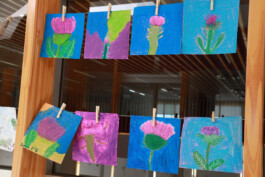
The cross in the shape of an “X” is the Scottish symbol, and the thistle is its national flower.
St. Andrew's Day is November 30th
Tartan

Our uniform is based on the Lamont Ancient Tartan which is predominantly green, blue, black and white. This clan descends from the original Scots who crossed the sea from Ireland, where their original name meant “Lawgiver”.
“SIC ITUR AD ASTRA”, IS A PHRASE BY VIRGILIO WHICH MEANS
“SUCH IS THE WAY TO THE STARS”.

School Song

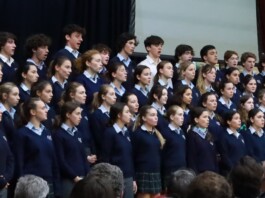
St. Andrew's you're our pride and joy
Sic itur ad astra
For every pupil girl or boy
Hip rah rah rah rah rah
St. Andrew's we will live to learn
To glorify your name
As we go marching on
We'll always guard your fame
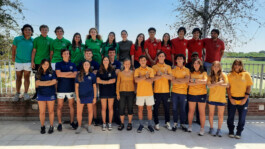
School Houses
Each one has its own representative color. Students are encouraged to defend and encourage their Houses through the various competitions held throughout the year.
These Inter-House competitions include General Knowledge, Sports, Music and Debate, among others.






A bilingual learning journey that stands in the present and projects towards the future
We educate in an immersive bilingual environment that not only promotes high standards of performance in multiple languages, but is also culturally sensitive to form citizens committed to an increasingly globalized and interconnected present and future.

A learning journey surrounded by experiences that foster academic training
We educate through experiences, camps, trips and tours, as an opportunity to re-signify and enhance learning experiences, bonding and institutional development of our students. We provide the opportunity to generate good relations between students, between students and teachers, between subjects and the environment, promoting independence, self-management and favoring the development of multiculturalism.

A learning journey that enables powerful relationships between all training areas
We educate so that each student has multiple opportunities to discover their interests and develop learning skills with high international standards in academic knowledge, in the arts, in physical education, and in new and emerging fields of knowledge, in a comprehensive and articulated manner throughout their entire schooling.

A learning journey open to change and innovation
We educate to develop skills that allow our students to be life-long learners in the face of a changing and technologically challenging world, promoting a proactive attitude towards the production of knowledge, through the critical use of various languages and technological environments.

A learning journey centered on each one and their community
We educate for the spiritual, emotional and social development and growth of each of our students, in an environment that promotes, on one hand, self-knowledge and, on the other, collective well-being that brings into play values and attitudes of life in community.
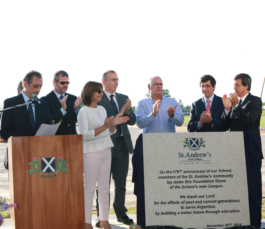
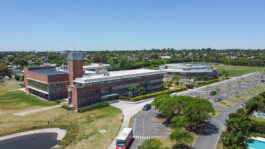
The design and development of the new Campus San Andrés is the result of several years of research and planning that involved much more than designing more spacious, bright, modern, efficient or functional buildings.
The Campus San Andrés constituted a unique opportunity to think about spaces for learning based on a new model derived from the important changes in the educational paradigm, and which profoundly and extremely beneficially affect education. We are the first generation that has access to all accumulated human knowledge, with the consequent redefinition of the role of educators and a great impact on the physical environment where learning takes place.
Our Campus is inspired by this educational project and will benefit our students and staff by allowing us to consolidate our school in one place, helping to create a true educational community.
Sports Field & Sports Pavilion
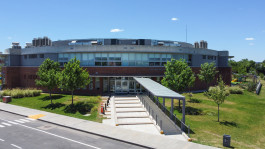
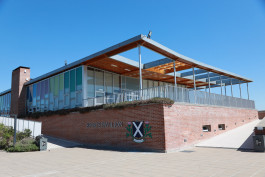
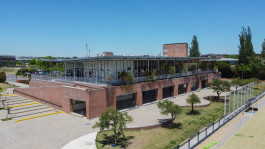
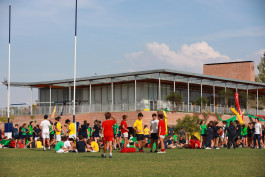
In 2015, with great enthusiasm we inaugurated the Sports Field and Sports Pavilion, a building that serves as backbone for all sporting activities and includes changing rooms, equipment room, P.E offices, teachers's staff room, infirmary and cafeteria.
With the new sports facilities on Campus, a new chapter in the history of St. Andrew's began.
Sports Field & Sports Pavilion
In 2015, with great enthusiasm we inaugurated the Sports Field and Sports Pavilion, a building that serves as backbone for all sporting activities and includes changing rooms, equipment room, P.E offices, teachers's staff room, infirmary and cafeteria.
With the new sports facilities on Campus, a new chapter in the history of St. Andrew's began.
Sports Field & Sports Pavilion
In 2015, with great enthusiasm we inaugurated the Sports Field and Sports Pavilion, a building that serves as backbone for all sporting activities and includes changing rooms, equipment room, P.E offices, teachers's staff room, infirmary and cafeteria.
With the new sports facilities on Campus, a new chapter in the history of St. Andrew's began.


Primary and Kinder
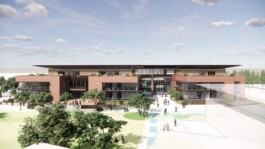
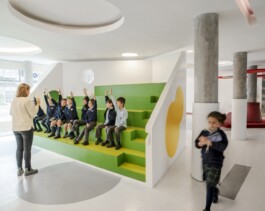
In 2019, the Campus was filled with life with the inauguration of the new Primary and Kinder buildings, in February and August respectively.
This new stage not only involved the move to the new Campus, but also the union of our historic sites in Olivos and Punta Chica, which were united in the same place, consolidating a true educational community made up of our students, families and staff.
Stage II - Primary and Kinder
In 2019, the Campus was filled with life with the inauguration of the new Primary and Kinder buildings, in February and August respectively.
This new stage not only involved the move to the new Campus, but also the union of our historic sites in Olivos and Punta Chica, which were united in the same place, consolidating a true educational community made up of our students, families and staff.
Stage II - Primary and Kinder
In 2019, the Campus was filled with life with the inauguration of the new Primary and Kinder buildings, in February and August respectively.
This new stage not only involved the move to the new Campus, but also the union of our historic sites in Olivos and Punta Chica, which were united in the same place, consolidating a true educational community made up of our students, families and staff.


Community Hub and Secondary
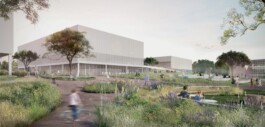
Today we are beginning a new stage of growth of our Campus, advancing in the construction of a new educational ecosystem. The Campus being consolidated as a space designed with architectural and pedagogical criteria that promotes meaningful education in our country.
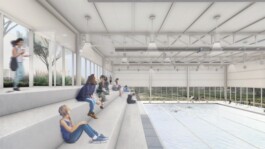
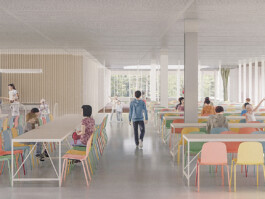
The Community Hub is made up of the Natatorium and the Dining Room and the Gymnasium/Auditorium. Soon we will begin work on our Natatorium, which houses two pools and changing rooms.
Community Hub and Secondary
Today we are beginning a new stage of growth of our Campus, advancing in the construction of a new educational ecosystem. The Campus being consolidated as a space designed with architectural and pedagogical criteria that promotes meaningful education in our country.
The Community Hub is made up of the Natatorium and the Dining Room and the Gymnasium/Auditorium. Soon we will begin work on our Natatorium, which houses two pools and changing rooms.
Community Hub and Secondary
Today we are beginning a new stage of growth of our Campus, advancing in the construction of a new educational ecosystem. The Campus being consolidated as a space designed with architectural and pedagogical criteria that promotes meaningful education in our country.
The Community Hub is made up of the Natatorium and the Dining Room and the Gymnasium/Auditorium. Soon we will begin work on our Natatorium, which houses two pools and changing rooms.
Community Hub and Secondary
Today we are beginning a new stage of growth of our Campus, advancing in the construction of a new educational ecosystem. The Campus being consolidated as a space designed with architectural and pedagogical criteria that promotes meaningful education in our country.
The Community Hub is made up of the Natatorium and the Dining Room and the Gymnasium/Auditorium. Soon we will begin work on our Natatorium, which houses two pools and changing rooms.
Community Hub and Secondary
Today we are beginning a new stage of growth of our Campus, advancing in the construction of a new educational ecosystem. The Campus being consolidated as a space designed with architectural and pedagogical criteria that promotes meaningful education in our country.
The Community Hub is made up of the Natatorium and the Dining Room and the Gymnasium/Auditorium. Soon we will begin work on our Natatorium, which houses two pools and changing rooms.
Its objective is exclusively academic or educational, and non-profit. Teaching and implementing other related activities within the country or abroad, at preschool, primary, secondary, tertiary, university, special or any other level, in accordance with the respective regulations. In the national, provincial and municipal order when carried out in the Argentine Republic, or in accordance with the regulations of the countries in which it may be implemented.

Chairman
Federico Fuchs (’90)
Vice Chairman
Gerardo Muniello
Treasurer
Clara Mendiberri
Secretary
Mariano Gilles
Members
Carola Fratini Lagos (’86)
Carla Bechelli
Guillermo Mac Kenzie
Miguel Stuart Milne (’98)
Max Rohm (’87)
Andrés Zenarruza (’86)
Alternants
Terence Roberts (’97)
Roberto Alexander (’82)
Roberto Bunge (h) (’01)
Statutory Auditor
Gerardo Croissant
Damián Balderian
Chairman
Jacqueline Truzzell (’90)
Vice Chairman
Carola Martin (’92)
Treasurer
Elizabeth Murchison
Secretary
Christian Hiba (’81)
Members
Ricardo Beller (’83)
Nicolás Clutterback (’90)
Alberto Ermili
Ricardo Mac Carthy (’79)
Members
Ximena Ibañez (’89)
C. Ronaldo Watson (’68)
Clara Mendiberri

Head of School
Lila Pinto

Secondary Head
Esteban Aranda

Secondary
Deputy Head
Marisa Márquez

Secondary
Deputy Head
James Thomas

Primary
Head
Maru López Fernandez

Primary Deputy Head
Andrea Jamieson

Primary Deputy Head
Mariela Homps

Learning Support Team Coordinator
Paula Tripodi

Kindergarten Head
Victoria Ayam (’94)

Kindergarten
Deputy Head
Verónica Muller (’96)

Kindergarten
Deputy Head
Sabrina Soneyra

Physical Education Director
Romina Fumo

Arts Leader
Axel Jeannot (’93)

Community & Outreach Director
Camila Vilcinskas (’96)

CFO / COO
Silvia Satas

Human Resources Director
Andrea Benvenuto (’87)

Admissions
Director
Ana Repila (’92)

Development & Communications Director
Eliana Mocorrea

Legal
Representative
Marta Cordo


St. Andrew's Scots School was established by a group of Scottish settlers to educate their children in their language, culture and faith. On September 1st 1838, thirteen years after their arrival, a tiny school was opened in the Presbyterian Church at Piedras 55, in the city of Buenos Aires. The first pupils were only girls but the school rapidly became co-educational.
The founders sought to integrate Christian faith and practice with academic distinction. In their eyes, education was an instrument of moral training, directed to its highest purpose when it is made not merely an exercise of the mind but a training of the opinions, disposition and habits. In character undoubtedly lies the essential elements of human happiness or human misery.
In 1885, the Scottish chapel building had to be demolished due to the extension work in Avenida de Mayo. The school, which was already growing, was relocated to Constitución district, to Ituzaingó 530, where, as proudly announced, 135 students of various nationalities attended: Scottish, English, Irish, French, Spanish, Italian and Argentine. The Church, meanwhile, moved to Avenida Belgrano and Perú, where it remains to this day. Some of the well remembered Headmasters of the school in those early days were Rev. William Brown, Rev. James Smith and, for a short period, Alexander Watson Hutton, who figures more generally in Argentine history as the pioneer of football in the country. In 1947, with the continual migration of the English-speaking community to the northern suburbs, the school was moved to Olivos. The premises at Nogoá 550 were, in fact, inaugurated as an all-boys school.
Over the years the school was firmly inserted in the wider Argentine community and in order to teach English to children who did not speak the language at home, in 1963, a kindergarten in English was opened in Olivos. St. Andrew's Scots School for Girls was opened in 1966 with the vision of preparing women to follow careers of their own choice. The school decided to return to co-educational in 1980 and the boys´and girls school were fully integrated. That same year a second primary school and kindergarten were inaugurated in Punta Chica to make room for a growing student body.
In an effort to further expand its already extensive experience in the pursuit of excellence and innovation in educating successive generations, the institution took a significant step in 1988 by entering the realm of higher education, giving birth to the University of San Andrés.
The primary aim of this visionary undertaking was to inject fresh perspectives into the Argentine educational field and provide a comprehensive, intellectually rigorous education to a diverse and exceptionally talented student body.
St. Andrew's has now stabilized as a school of approximately 2000 students who receive a fully bilingual education. All its students are expected to complete seven IGCSE exams (Cambridge University) in year 10 and receive an International Baccalaureate Diploma in their last year at school. This challenging education prepares its graduates to enter universities all around the world and, more significantly, should provide them with the disposition and habits that allow them to become thoughtful and caring citizens.

TIMELINE
1825
Arrival of the Symmetry with 250 Scots who settle in Monte Grande
1826
Rivadavia
1829
1st term of Rosas
1835
2nd term of Rosas
1838-1840
French blockade of the Río de la Plata
1838
Inauguration of the St. Andrew's Scottish School for girls
1839
Boys are admitted to the school
1852
Battle of Caseros
1853
The National Constitution is sanctioned
1854
J.J. Urquiza
1868
Domingo F. Sarmiento
1871
Yellow fever epidemic
1880
1st term of Julio A. Roca
1881
James Dodds is appointed Treasurer
1885
Rev. James W. Fleming returns to the School
1889
Expropriation and demolition of the School
1895
Inauguration of the new St. Andrew's School building
1898
2nd term of Julio A. Roca
1911
Foundation of the St. Andrew's Former Pupils Club
1914
World War I
1916
1st term of Hipólito de Irigoyen
1928
2nd term of Hipólito Irigoyen
1930
Coup d'État
1933
John Monteith Drysdale appointed President of the School
1939
World War II
1946
1st term of Juan D. Perón
1947
Inauguration of the St. Andrew's Scottish School building
1952
2nd term of Juan D. Perón
1963
Arturo Illia
1963
The sports field in Punta Chica is inaugurated
1963
The Olivos Kindergarten is inaugurated
1966
The girls' section in Olivos is inaugurated
1967
The secondary school opens at the girls' school
1969
The new Kindergarten building in Olivos is inaugurated
1970
The Davidson Scholarship begins
1973
3rd term of Juan D. Perón
1974
María Estela Martínez de Perón
1976
Rodrigazo: Coup d'État
1980
The boys' and girls' sections are integrated
1982
Falklands War
1983
Raúl Alfonsín
1985
Inauguration of the W.P. Hardie Hall in Punta Chica
1987
Opening of the new laboratories building
1989
1st term of Carlos S. Menem
1989
University of San Andrés is inaugurated
1990
IGCSE replaces Cambridge O Level exams
1991
The Olivos Kindergarten is relocated
1992
The Art building in Olivos is inaugurated
1995
2nd term of Carlos S. Menem
1996
IB teaching begins and the Music building is inaugurated
1997
Construction of the new Middle School building
1999
Fernando De la Rúa
2001
Argentine peso devaluation. Fall of De la Rúa's government
2001
Ramón Puerta, Adolfo Rodríguez Saa, Eduardo Camaño
2002
Eduardo Duhalde
2002
Creation of the Alumni Office
2003
Creation of the St. Andrew's Scots School Scholarship Endowment Fund
2003
Néstor Kirchner
2004
Creation of RedSA
The garden of Olivos is remodeled and named Anne E. Truzzell Pavilion
2005
The Maggie Salinas Fund is established
St. Andrew's Scots School World War II Memorial
25th Anniversary of the Punta Chica campus
2007
Cristina Fernández de Kirchner
2007
The Former Pupil Award is established
2008
170th Anniversary
Initiation of the St. Andrew's Scottish School Museum project
2009
A plot of land in San Fernando is acquired for the new SASS Campus
2011
Reelection of Cristina Fernández de Kirchner
Construction begins on the new Campus
2013
175th Anniversary
2015
Mauricio Macri
Inauguration of Phase I - Campus Sports Pavilion and Sports Field
2016
Creation of CASA (San Andrés Extended Community)
2017
Start of K2 in all campuses
Opening of K2 and K3 at the Campus
Construction of Phase II - Primary School at the Campus begins
2018
180th Anniversary
Construction of Phase II - Kinder at the Campus begins
2019
Inauguration of Phase II - Primary Campus and Kinder Campus
2019
Alberto Fernández
2023
185th Anniversary
Masterplan review Phase III - Secondary School and Community Hub
2023
Presidency of Milei

St. Andrew's Scots School aims to graduate responsible citizens committed to serving Argentina and contributing to its equitable development through a well-balanced, bilingual education which meets high international standards and fosters a joy for learning.
Pupils are taught to inquire deeply, work responsibly and care for others, themselves and the environment.
We build their character in a diverse and respectful community, expecting high standards of discipline and commitment, supporting them to reach their full potential and nurturing their intellectual, emotional, physical and spiritual dimensions.
The ethic and moral foundations of St. Andrew's Scots School are anchored in its Presbyterian heritage, rooted in the sacred scriptures.
As a community, which seeks the flourishing of all its members within and beyond the school, St. Andrew's Scots School affirms its commitment to enshrine certain ideas throughout all teaching, administrative and organizational activities.
The first of these is consideration for the needs, rights, interests and feelings of each person; a steady disposition to treat others as we ourselves would wish to be treated.
This is enshrined in the universal precept of the “Golden Rule”, the practical habit of “loving our neighbours as ourselves”. The active expression of this attitude is characterised by such virtues as:
Integrity
Respect
Responsibility
These virtues need to be espoused in a spirit of openness, as a commitment to them calls for discovery and renewal in our life as members of the community.

Our School Shield
Composed by a navy blue shield with a white transversal cross surrounded by a thistle floral emblem. The cross in the shape of an “X” is the Scottish symbol, and the thistle is its national flower. Our motto “SIC ITUR AD ASTRA”, is a phrase by Virgilio which means “Such is the way to the stars”. St. Andrew's Day is November 30th.
Tartan
Our uniform is based on the Lamont Ancient Tartan which is predominantly green, blue, black and white. This clan descends from the original Scots who crossed the sea from Ireland, where their original name meant “Lawgiver”.
School Song
St. Andrew's you're our pride and joy
Sic itur ad astra
For every pupil girl or boy
Hip rah rah rah rah rah
St. Andrew's we will live to learn
To glorify your name
As we go marching on
We'll always guard your fame
Our School Shield
Composed by a navy blue shield with a white transversal cross surrounded by a thistle floral emblem.
The cross in the shape of an “X” is the Scottish symbol, and the thistle is its national flower.
St. Andrew's Day is November 30th
Tartan

El tartan de nuestro uniforme se basa en el del Clan Lamont, en el que predominan los colores azul, verde, negro y blanco. Este Clan desciende de los antiguos escoceses que cruzaron el mar desde Irlanda, donde su nombre significa “impartidor de leyes”.
School Song

St. Andrew's you're our pride and joy
Sic itur ad astra
For every pupil girl or boy
Hip rah rah rah rah rah
St. Andrew's we will live to learn
To glorify your name
As we go marching on
We'll always guard your fame

School Houses
Each one has its own representative color. Students are encouraged to defend and encourage their Houses through the various competitions held throughout the year.
These Inter-House competitions include General Knowledge, Sports, Music and Debate, among others.


A bilingual learning journey that stands in the present and projects towards the future
We educate in an immersive bilingual environment that not only promotes high standards of performance in multiple languages, but is also culturally sensitive to form citizens committed to an increasingly globalized and interconnected present and future.

A learning journey surrounded by experiences that foster academic training
We educate through experiences, camps, trips and tours, as an opportunity to re-signify and enhance learning experiences, bonding and institutional development of our students. We provide the opportunity to generate good relations between students, between students and teachers, between subjects and the environment, promoting independence, self-management and favoring the development of multiculturalism.

A learning journey that enables powerful relationships between all training areas
We educate so that each student has multiple opportunities to discover their interests and develop learning skills with high international standards in academic knowledge, in the arts, in physical education, and in new and emerging fields of knowledge, in a comprehensive and articulated manner throughout their entire schooling.

A learning journey open to change and innovation
We educate to develop skills that allow our students to be life-long learners in the face of a changing and technologically challenging world, promoting a proactive attitude towards the production of knowledge, through the critical use of various languages and technological environments.

A learning journey centered on each one and their community
We educate for the spiritual, emotional and social development and growth of each of our students, in an environment that promotes, on one hand, self-knowledge and, on the other, collective well-being that brings into play values and attitudes of life in community.

A bilingual learning journey that stands in the present and projects towards the future
We educate in an immersive bilingual environment that not only promotes high standards of performance in multiple languages, but is also culturally sensitive to form citizens committed to an increasingly globalized and interconnected present and future.

A learning journey surrounded by experiences that foster academic training
We educate through experiences, camps, trips and tours, as an opportunity to re-signify and enhance learning experiences, bonding and institutional development of our students. We provide the opportunity to generate good relations between students, between students and teachers, between subjects and the environment, promoting independence, self-management and favoring the development of multiculturalism.

A learning journey that enables powerful relationships between all training areas
We educate so that each student has multiple opportunities to discover their interests and develop learning skills with high international standards in academic knowledge, in the arts, in physical education, and in new and emerging fields of knowledge, in a comprehensive and articulated manner throughout their entire schooling.

A learning journey open to change and innovation
We educate to develop skills that allow our students to be life-long learners in the face of a changing and technologically challenging world, promoting a proactive attitude towards the production of knowledge, through the critical use of various languages and technological environments.

A learning journey centered on each one and their community
We educate for the spiritual, emotional and social development and growth of each of our students, in an environment that promotes, on one hand, self-knowledge and, on the other, collective well-being that brings into play values and attitudes of life in community.

The design and development of the new Campus San Andrés is the result of several years of research and planning that involved much more than designing more spacious, bright, modern, efficient or functional buildings.
The Campus San Andrés constituted a unique opportunity to think about spaces for learning based on a new model derived from the important changes in the educational paradigm, and which profoundly and extremely beneficially affect education. We are the first generation that has access to all accumulated human knowledge, with the consequent redefinition of the role of educators and a great impact on the physical environment where learning takes place.
Our Campus is inspired by this educational project and will benefit our students and staff by allowing us to consolidate our school in one place, helping to create a true educational community.
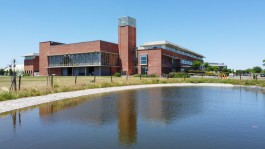


Sports Field & Sports Pavilion
In 2015, with great enthusiasm we inaugurated the Sports Field and Sports Pavilion, a building that serves as backbone for all sporting activities and includes changing rooms, equipment room, P.E offices, teachers's staff room, infirmary and cafeteria.
With the new sports facilities on Campus, a new chapter in the history of St. Andrew's began.
Sports Field & Sports Pavilion
In 2015, with great enthusiasm we inaugurated the Sports Field and Sports Pavilion, a building that serves as backbone for all sporting activities and includes changing rooms, equipment room, P.E offices, teachers's staff room, infirmary and cafeteria.
With the new sports facilities on Campus, a new chapter in the history of St. Andrew's began.
Sports Field & Sports Pavilion
In 2015, with great enthusiasm we inaugurated the Sports Field and Sports Pavilion, a building that serves as backbone for all sporting activities and includes changing rooms, equipment room, P.E offices, teachers's staff room, infirmary and cafeteria.
With the new sports facilities on Campus, a new chapter in the history of St. Andrew's began.


Primary and Kinder
In 2019, the Campus was filled with life with the inauguration of the new Primary and Kinder buildings, in February and August respectively.
This new stage not only involved the move to the new Campus, but also the union of our historic sites in Olivos and Punta Chica, which were united in the same place, consolidating a true educational community made up of our students, families and staff.
Stage II - Primary and Kinder
In 2019, the Campus was filled with life with the inauguration of the new Primary and Kinder buildings, in February and August respectively.
This new stage not only involved the move to the new Campus, but also the union of our historic sites in Olivos and Punta Chica, which were united in the same place, consolidating a true educational community made up of our students, families and staff.
Stage II - Primary and Kinder
In 2019, the Campus was filled with life with the inauguration of the new Primary and Kinder buildings, in February and August respectively.
This new stage not only involved the move to the new Campus, but also the union of our historic sites in Olivos and Punta Chica, which were united in the same place, consolidating a true educational community made up of our students, families and staff.


Community Hub and Secondary
Today we are beginning a new stage of growth of our Campus, advancing in the construction of a new educational ecosystem. The Campus being consolidated as a space designed with architectural and pedagogical criteria that promotes meaningful education in our country.
The Community Hub is made up of the Natatorium and the Dining Room and the Gymnasium/Auditorium. Soon we will begin work on our Natatorium, which houses two pools and changing rooms.
Community Hub and Secondary
Today we are beginning a new stage of growth of our Campus, advancing in the construction of a new educational ecosystem. The Campus being consolidated as a space designed with architectural and pedagogical criteria that promotes meaningful education in our country.
The Community Hub is made up of the Natatorium and the Dining Room and the Gymnasium/Auditorium. Soon we will begin work on our Natatorium, which houses two pools and changing rooms.
Community Hub and Secondary
Today we are beginning a new stage of growth of our Campus, advancing in the construction of a new educational ecosystem. The Campus being consolidated as a space designed with architectural and pedagogical criteria that promotes meaningful education in our country.
The Community Hub is made up of the Natatorium and the Dining Room and the Gymnasium/Auditorium. Soon we will begin work on our Natatorium, which houses two pools and changing rooms.
Community Hub and Secondary
Today we are beginning a new stage of growth of our Campus, advancing in the construction of a new educational ecosystem. The Campus being consolidated as a space designed with architectural and pedagogical criteria that promotes meaningful education in our country.
The Community Hub is made up of the Natatorium and the Dining Room and the Gymnasium/Auditorium. Soon we will begin work on our Natatorium, which houses two pools and changing rooms.
Community Hub and Secondary
Today we are beginning a new stage of growth of our Campus, advancing in the construction of a new educational ecosystem. The Campus being consolidated as a space designed with architectural and pedagogical criteria that promotes meaningful education in our country.
The Community Hub is made up of the Natatorium and the Dining Room and the Gymnasium/Auditorium. Soon we will begin work on our Natatorium, which houses two pools and changing rooms.

Its objective is exclusively academic or educational, and non-profit. Teaching and implementing other related activities within the country or abroad, at preschool, primary, secondary, tertiary, university, special or any other level, in accordance with the respective regulations. In the national, provincial and municipal order when carried out in the Argentine Republic, or in accordance with the regulations of the countries in which it may be implemented.
Chairman
Federico Fuchs (’90)
Vice Chairman
Gerardo Muniello
Treasurer
Clara Mendiberri
Secretary
Mariano Gilles
Members
Carola Fratini Lagos (’86)
Carla Bechelli
Guillermo Mac Kenzie
Miguel Stuart Milne (’98)
Max Rohm (’87)
Andrés Zenarruza (’86)
Alternants
Terence Roberts (’97)
Roberto Alexander (’82)
Roberto Bunge (h) (’01)
Statutory Auditor
Gerardo Croissant
Damián Balderian
Chairman
Jacqueline Truzzell (’90)
Vice Chairman
Carola Martin (’92)
Treasurer
Elizabeth Murchison
Secretary
Christian Hiba (’81)
Members
Ricardo Beller (’83)
Nicolás Clutterback (’90)
Alberto Ermili
Ricardo Mac Carthy (’79)
Members
Ximena Ibañez (’89)
C. Ronaldo Watson (’68)
Clara Mendiberri

Head of School
Lila Pinto

Secondary Head
Esteban Aranda

Secondary
Deputy Head
Marisa Márquez

Secondary
Deputy Head
James Thomas

Primary
Head
Maru López Fernandez

Primary Deputy Head
Andrea Jamieson

Primary Deputy Head
Mariela Homps

Learning Support Team Coordinator
Paula Tripodi

Kindergarten Head
Victoria Ayam (’94)

Kindergarten
Deputy Head
Verónica Muller (’96)

Kindergarten
Deputy Head
Sabrina Soneyra

Physical Education Director
Romina Fumo

Arts Leader
Axel Jeannot (’93)

REDSA y San Fernando
En Red Director
Camila Vilcinskas (’96)

CFO / COO
Silvia Satas

HHRR Director
Andrea Benvenuto (’87)

Admissions
Director
Ana Repila (’92)

Development &
Com. Director
Eliana Mocorrea

Legal
Representative
Marta Cordo